Selena Quintanilla | Biography, Songs, Family & Legacy
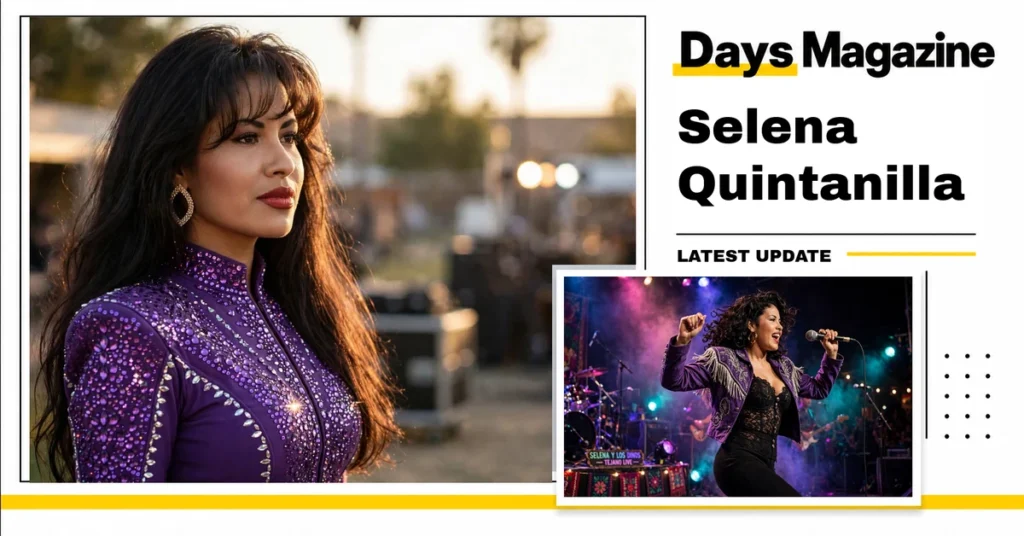
Selena Quintanilla, known professionally as Selena, was a Mexican-American singer, songwriter, fashion designer, and business owner who helped bring Tejano music to a wider audience.
Born in Texas in 1971, she rose to fame with her family band, Selena y Los Dinos, and won a Grammy before her murder at age 23 in 1995. Her music and style still reach new generations.
Who Is Selena Quintanilla?
Selena Quintanilla-Pérez is remembered as the Queen of Tejano Music, a title earned through her strong voice, lively performances, and ability to blend regional Mexican styles with pop. She became a major Latin music star in the early 1990s and was preparing for a wider English-language career when her life was cut short.
| Fact | Details |
|---|---|
| Full name | Selena Quintanilla-Pérez |
| Known professionally as | Selena |
| Birthday | April 16, 1971 |
| Birthplace | Lake Jackson, Texas, United States |
| Died | March 31, 1995, in Corpus Christi, Texas |
| Age at death | 23 |
| Husband | Chris Pérez, married in 1992 |
| Parents | Marcella Samora and Abraham Quintanilla Jr. |
| Known for | Tejano music, cumbia, Latin pop, fashion design |
| Grammy win | Best Mexican-American Album for Selena Live in 1994 |
When Was Selena Quintanilla Born, and What Was Her Early Life Like?
Selena was born on April 16, 1971, in Lake Jackson, Texas, and began performing as a child. Her father, Abraham Quintanilla Jr., had been a musician and recognized her talent early. He taught his children music and helped build a family group around Selena.
She began singing with Selena y Los Dinos at about eight years old. The group first played at family gatherings, weddings, and the restaurant her family operated. In 1982, the family moved to Corpus Christi, where the band worked local clubs and dance halls while building a following.
Selena attended school in Lake Jackson and Corpus Christi, then completed high school through a correspondence program in 1989. English was her first language, and she initially learned Spanish song lyrics by sound so she could perform for Spanish-speaking audiences. With practice, she became more comfortable singing in Spanish.
Who Were Selena Quintanilla’s Parents, Brother, and Sister?
Selena’s immediate family included her parents, Abraham Quintanilla Jr. and Marcella Samora, her older brother A.B. Quintanilla III, and her older sister Suzette Quintanilla. Her family was also her first band and a key part of her professional life.
A.B. became a songwriter, bassist, and producer for Selena y Los Dinos, while Suzette played drums. Their father managed the group and helped guide Selena’s career. Abraham died on December 13, 2025, at age 86, according to family announcements reported by news outlets. Marcella was named among his survivors in that coverage.
Selena married guitarist Chris Pérez in 1992. The couple had no children before her death in 1995.
What Are Selena Quintanilla’s Most Famous Songs and Albums?
Selena’s best-known songs include romantic ballads and dance tracks that brought Tejano music to listeners beyond its traditional audience. Her recordings often mixed Tejano, cumbia, pop, and other Latin styles, creating a sound that worked in clubs, on radio, and on large stages.
Her breakthrough albums included Ven Conmigo, Entre a Mi Mundo, Selena Live, and Amor Prohibido. Dreaming of You, released after her death in July 1995, introduced more of her music to mainstream pop audiences and debuted at No. 1 on the Billboard 200.
Songs closely linked with Selena include:
- “Como la Flor,” a signature song about heartbreak and letting go.
- “Bidi Bidi Bom Bom,” a bright, rhythm-driven hit.
- “Amor Prohibido,” the title track of her 1994 album.
- “No Me Queda Más,” a ballad that became one of her best-known recordings.
- “Dreaming of You,” a crossover single released after her death.
What Did Selena Quintanilla Accomplish in Her Career?
Selena helped move Tejano music into the wider U.S. music market at a time when the genre had limited mainstream attention. Her success was built on years of touring, a close family band, and a growing audience in the United States and Mexico.
Her most notable career milestones include:
- Won the 1994 Grammy for Best Mexican-American Album for Selena Live, becoming the first female Tejano artist to win the category.
- Earned a Grammy nomination for Amor Prohibido in 1995.
- Helped bring Tejano and cumbia-influenced music to larger audiences in the United States and Mexico.
- Her posthumous album Dreaming of You reached No. 1 on the Billboard 200.
Her honors continued after her death. She received a Grammy Lifetime Achievement Award in 2021, and the National Medal of Arts was presented posthumously in 2023.
Who Was Selena Quintanilla’s Husband?
Selena’s husband was Chris Pérez, a guitarist who joined Selena y Los Dinos in 1990. The pair began dating privately, and they married on April 2, 1992, after Selena’s father initially disapproved of the relationship.
The couple remained married until Selena’s death in 1995. Pérez later wrote about their relationship in his memoir To Selena, with Love and has continued to speak publicly about her music and legacy.
Their story has also appeared in biographies and screen adaptations, but their real relationship was more complex than any single film can show.
How Did Selena Quintanilla Become a Fashion Icon?
Selena became a fashion icon by combining bold stage clothing with a personal style that felt approachable to her fans. Her looks often included fitted tops, high-waisted pants, sparkling details, and performance outfits designed to move with her energetic shows.
She began developing her own clothing line in 1992 and opened Selena Etc., a boutique and salon business, in Corpus Christi and San Antonio in 1994. The stores expanded her work beyond music and reflected her interest in design and business.
Her stage outfits, jewelry, and personal items are now part of the collection shown at the Selena Museum.
Her style continues to inspire concert costumes, fan art, makeup looks, and photo shoots. Although some searches focus on a particular Selena costume or hairstyle, her public image changed over time rather than staying fixed to one look.
How Did Selena Quintanilla Die, and Who Killed Her?
Selena died on March 31, 1995, after being shot by Yolanda Saldívar, the former president of her fan club and manager of her boutiques. The shooting took place at a Days Inn motel in Corpus Christi, Texas, during a meeting about business records.
The dispute involved financial irregularities and suspected missing money. Prosecutors argued that Saldívar shot Selena as their business relationship was falling apart, while Saldívar claimed the gun went off accidentally. A jury found Saldívar guilty of murder on October 23, 1995, and she received a life sentence.
The medical examiner ruled Selena’s death a homicide caused by severe blood loss from a gunshot wound to the chest that damaged a major artery. She was 23 and only weeks away from her 24th birthday. Saldívar was denied parole in 2025 and is next eligible for review in 2030, according to news reports.
What Were Selena Quintanilla’s Last Words?
At her murder trial, motel desk clerk Shawna Vela testified that Selena identified her attacker and the room where the shooting happened by saying, “Yolanda, 158.” Other witness accounts include her cries for help and warning staff to lock the door.
These are trial witnesses’ recollections, not a recording, so the exact wording should be presented with that context.
How Is Selena Quintanilla Remembered Today?
Selena’s legacy lives on through her music, fashion, family archives, and public tributes. The Quintanilla family opened the Selena Museum in Corpus Christi in 1998. It displays personal items, awards, photographs, and stage outfits, allowing visitors to learn about her life beyond the headlines.
The 1997 film Selena, starring Jennifer Lopez, introduced her story to another generation. The 2025 documentary Selena y Los Dinos: A Family’s Legacy drew on family footage and interviews to focus on the band and the people who knew her.
Her often-cited advice, “If you have a dream, don’t let anybody take it away,” captures the determination many fans associate with her career.
Her influence is not limited to awards or tributes. Selena helped make Tejano music more visible across the United States and showed that a Mexican-American artist could connect with audiences across language and genre lines.
Her story is part of a wider collection of music lives, including Dolly Parton, Madonna, and Aretha Franklin. Readers can continue with Bob Marley and Liza Minnelli, country favorite Shania Twain, or the companion biography Selena. Soul and modern voices follow with Erykah Badu, Shaboozey, and Lewis Capaldi.
Conclusion
Selena Quintanilla’s story combines musical achievement, family teamwork, creative ambition, and a life ended far too soon. Her Grammy-winning work helped expand the reach of Tejano music, while her songs and fashion remain part of popular culture. Remembering her means recognizing both the artist she became and the wider doors she helped open.