Anne Rice Biography | Books, Family, Career & Legacy
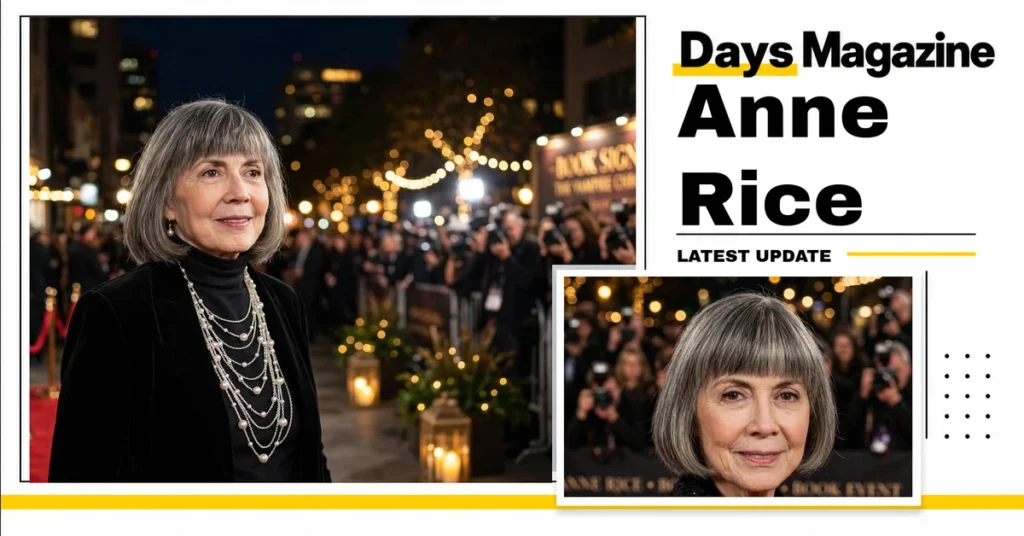
Anne Rice was an American novelist best known for The Vampire Chronicles, beginning with Interview with the Vampire in 1976. Her richly detailed Gothic fiction made vampires complex figures who wrestled with love, identity, faith, and mortality. She also wrote stories about witches, historical outsiders, and religion before her death in 2021.
Who Is Anne Rice?
Anne Rice was a bestselling American author whose supernatural novels helped reshape modern Gothic fiction. Her stories combined lush settings, morally complicated characters, and big questions about life, belief, grief, and immortality.
| Full name | Howard Allen O’Brien, later known as Anne Rice |
|---|---|
| Born | October 4, 1941 |
| Birthplace | New Orleans, Louisiana, United States |
| Died | December 11, 2021 |
| Age at death | 80 |
| Education | B.A. in Political Science, 1964; M.A. in Creative Writing, 1972 |
| Spouse | Stan Rice, married October 14, 1961 |
| Children | Michele Rice and Christopher Rice |
| Best known for | The Vampire Chronicles and The Lives of the Mayfair Witches |
What Was Anne Rice’s Early Life Like?
Anne Rice was born Howard Allen O’Brien in New Orleans on October 4, 1941, and began using the name Anne when she entered first grade. Her father, Howard O’Brien, worked for the postal service, while her mother, Katherine, helped shape the Catholic home in which Rice grew up.
Rice spent much of her childhood in the city’s Irish Channel neighborhood, close to the old houses, cemeteries, and contrasting streets that later gave her fiction its strong sense of place. Her mother died in 1956, when Rice was 14, and the family moved to Richardson, Texas, where Rice finished high school.
What Did Anne Rice Study Before Becoming a Writer?
Rice studied at Texas Woman’s University and North Texas State College before continuing her education in California. At San Francisco State University, then called San Francisco State College, she earned a bachelor’s degree in political science in 1964 and a master’s degree in creative writing in 1972.
Before becoming a full-time novelist, Rice worked in several jobs, including as a waitress, cook, theater usher, and insurance claims examiner. She married poet and painter Stan Rice in 1961, and the couple built a family life that remained closely tied to literature and art.
Who Were Anne Rice’s Husband and Children?
Anne Rice was married to poet and painter Stan Rice for more than 41 years, until his death from brain cancer on December 9, 2002. They had two children: Michele, who died of leukemia in 1972 at age five, and Christopher Rice, who became a novelist.
The loss of Michele deeply affected both parents. Rice later described how grief shaped the story that became Interview with the Vampire, while the character Lestat was partly inspired by her husband. These connections help explain why her supernatural fiction often treats loss and longing as seriously as horror.
How Did Interview with the Vampire Make Anne Rice Famous?
Interview with the Vampire was published in 1976 and introduced readers to Louis, a vampire who recounts his long life to a journalist. Lestat, Claudia, and the other vampires are not simply monsters in the novel; they struggle with guilt, desire, loneliness, and what it means to remain human.
The book became the starting point for the Vampire Chronicles, a series that grew across decades and drew readers to Rice’s layered, emotionally intense approach to the supernatural. The 1994 film adaptation starred Tom Cruise, Brad Pitt, Kirsten Dunst, and Antonio Banderas.
In October 2026, a 50th anniversary edition of the novel was released with a new foreword by Leigh Bardugo, an afterword by Christopher Rice, and material from the original manuscript.
Which Books and Series Define Anne Rice’s Career?
Rice wrote across Gothic horror, historical fiction, fantasy, erotica, and religious fiction. Her best-known books and series include:
- The Vampire Chronicles: A 13-book series that began with Interview with the Vampire and continued through Blood Communion: A Tale of Prince Lestat in 2018.
- The Lives of the Mayfair Witches: A family saga launched by The Witching Hour (1990), followed by Lasher (1993) and Taltos (1994).
- Historical novels: The Feast of All Saints (1979) explores free people of color in nineteenth-century New Orleans, while Cry to Heaven (1982) is set in the world of eighteenth-century Italian opera.
- The Sleeping Beauty books: A sequence of erotic novels published under the name A. N. Roquelaure, beginning with The Claiming of Sleeping Beauty in 1983.
- Other supernatural fiction: The Mummy, or Ramses the Damned (1989) draws on ancient Egypt, while The Wolf Gift (2012) begins a series about a modern werewolf.
What Is the Correct Order of the Vampire Chronicles?
The main Vampire Chronicles sequence contains 13 novels, beginning with Interview with the Vampire and ending with Blood Communion: A Tale of Prince Lestat. The publication order is the clearest reading path for following Lestat’s changing role and the series’ expanding supernatural world.
| Order | Novel | Year |
|---|---|---|
| 1 | Interview with the Vampire | 1976 |
| 2 | The Vampire Lestat | 1985 |
| 3 | The Queen of the Damned | 1988 |
| 4 | The Tale of the Body Thief | 1992 |
| 5 | Memnoch the Devil | 1995 |
| 6 | The Vampire Armand | 1998 |
| 7 | Merrick | 2000 |
| 8 | Blood and Gold | 2001 |
| 9 | Blackwood Farm | 2002 |
| 10 | Blood Canticle | 2003 |
| 11 | Prince Lestat | 2014 |
| 12 | Prince Lestat and the Realms of Atlantis | 2016 |
| 13 | Blood Communion: A Tale of Prince Lestat | 2018 |
How Are The Mayfair Witches and the Talamasca Connected?
The Mayfair novels follow a powerful New Orleans family whose history is bound to witchcraft and a dangerous supernatural presence. The original trilogy consists of The Witching Hour, Lasher, and Taltos, while later novels such as Merrick, Blackwood Farm, and Blood Canticle bring the Mayfair story into the wider Vampire Chronicles world.
The Talamasca is a secretive organization in Rice’s fiction that studies and tracks supernatural beings, including vampires and witches. AMC adapted this part of the fictional world in Anne Rice’s Talamasca: The Secret Order, which premiered in 2025 as part of the connected Anne Rice Immortal Universe.
Did Anne Rice Write Under Other Names?
Yes. Rice used the pen names A. N. Roquelaure and Anne Rampling for erotic fiction, which allowed her to explore material different from the Gothic novels published under her best-known name. The Sleeping Beauty books appeared as A. N. Roquelaure, while titles such as Exit to Eden and Belinda were published under Anne Rampling.
How Did Anne Rice’s Religious Beliefs Affect Her Books?
Rice’s relationship with religion changed over her lifetime and became a major part of her writing. Raised Catholic, she moved away from organized religion as a young adult, returned to Catholicism in 1998, and later dedicated her work to exploring Jesus and Christian history.
That period produced Christ the Lord: Out of Egypt (2005), Christ the Lord: The Road to Cana (2008), and the spiritual memoir Called Out of Darkness (2008).
In 2010, Rice publicly said she was leaving organized Christianity because of her objections to its positions on social issues, while making clear that she remained committed to Christ. Her work repeatedly returns to questions of faith, doubt, and the possibility of meaning in a difficult world.
What Was Anne Rice’s Net Worth?
Anne Rice’s exact net worth was not publicly verified through an audited estate valuation. Some celebrity finance websites estimate her wealth at about $60 million at the time of her death, but that figure is unconfirmed and should be treated as a rough online estimate rather than an established financial fact.
Her commercial success came from decades of bestselling books, film and television adaptations, and international readership. The lasting value of her work is also reflected in new editions of her novels and continued screen adaptations, though neither sales figures nor adaptation deals reveal the precise value of her estate.
Is Anne Rice Still Alive?
No. Anne Rice died on December 11, 2021, at age 80, after complications from a stroke. Her son Christopher announced her death, and readers and fellow writers remembered her for creating a distinctive fictional world that influenced generations of vampire and supernatural storytelling.
What Movies and TV Shows Are Based on Anne Rice’s Books?
Rice’s best-known screen adaptation is the 1994 film Interview with the Vampire, followed by the 2002 film Queen of the Damned. Her novel The Feast of All Saints was adapted as a television miniseries in 2001, and later adaptations brought her vampires, witches, and secret societies to television audiences.
AMC’s connected series began with Interview with the Vampire and expanded to Mayfair Witches and Talamasca: The Secret Order. In 2026, the third season of the vampire series aired under the title The Vampire Lestat.
AMC announced a fourth season titled Anne Rice’s Queen of the Damned in July 2026, while the third season of Mayfair Witches is planned for 2027.
What Was Anne Rice’s Connection to New Orleans?
New Orleans was central to Rice’s identity and imagination, not just a setting she used for atmosphere. The city’s Catholic traditions, historic neighborhoods, cemeteries, and contrasts between wealth and hardship appear throughout her fiction, especially in The Witching Hour and Interview with the Vampire.
Rice and her family once lived in the Garden District home known as the Brevard-Clapp-Rice House at 1239 First Street. The mansion helped inspire Mayfair Manor in The Witching Hour, and the city’s architecture and folklore remain key parts of how readers picture her supernatural world.
If you enjoyed learning about Anne Rice, you may also like our biographies of Stephen King, Colleen Hoover, Sarah J Maas, Rebecca Yarros, Brandon Sanderson, John Green, Danielle Steel, and Steve Hamilton.
Conclusion
Anne Rice’s legacy rests on her ability to turn supernatural figures into complicated characters with human fears and desires. Through vampires, witches, historical outsiders, and religious figures, she explored grief, freedom, identity, and belief without limiting herself to one genre.
Her books continue to reach new readers through anniversary editions and screen adaptations. More than a writer of vampire stories, Rice built a broad fictional universe that gave Gothic fiction new emotional depth and secured her place in modern popular literature.