Dolly Parton Biography | Age, Songs, Husband & Legacy
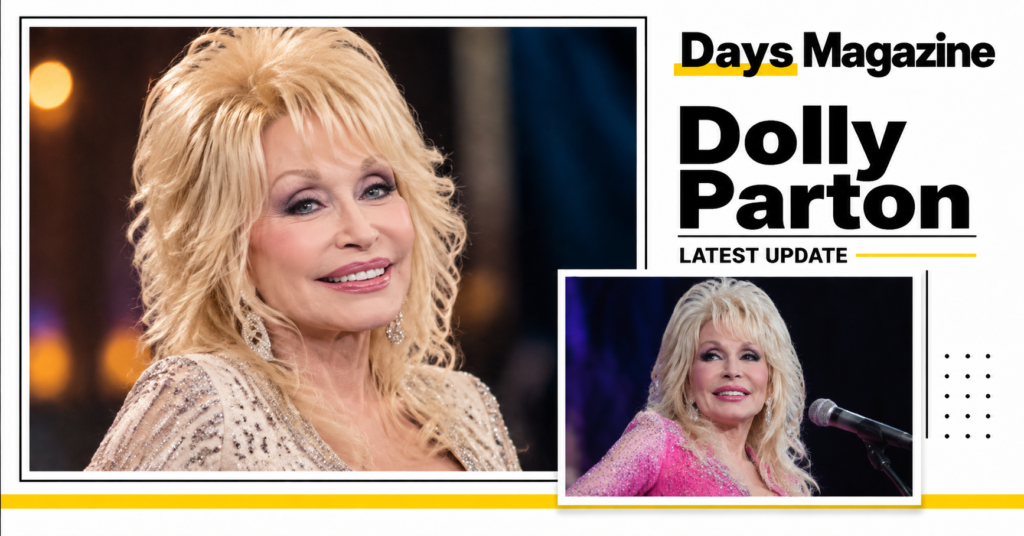
Dolly Parton was an American singer-songwriter, actress, author and philanthropist whose songs and business ventures made her one of country music’s most recognizable figures. She died on August 25, 2026, at age 80 after a brief battle with cancer, according to her representatives. The type of cancer was not publicly disclosed.
Who Is Dolly Parton?
Dolly Parton was a country music legend whose work reached far beyond radio and concert stages. She became known for sharp, story-driven songwriting, a warm sense of humor, a bold public image and a long record of support for children’s literacy. Her career connected Appalachian music traditions with country, pop, film, television and family entertainment.
| Full name | Dolly Rebecca Parton |
| Born | January 19, 1946 |
| Died | August 25, 2026 |
| Age at death | 80 |
| Birthplace | Locust Ridge, Sevier County, Tennessee |
| Spouse | Carl Dean; married in 1966, died in 2025 |
| Children | None |
| Occupation | Singer-songwriter, actress, author, producer and philanthropist |
| Estimated net worth | About $450 million before her death, according to Forbes |
Did Dolly Parton Die, and What Was the Cause?
Yes. Dolly Parton died in Nashville on August 25, 2026, at age 80. Her representatives said she had faced a brief battle with cancer, but they did not identify the type of cancer, so claims naming a specific cancer are not confirmed by the public statements.
In May 2026, Parton canceled a planned Las Vegas residency after discussing health challenges and the dizziness caused by some medications and treatments. She had reassured fans that her conditions were treatable and that she was responding to care.
The later statement about cancer provided the confirmed explanation for her final illness, but further medical details were not released.
Early Life, Family and Siblings
Parton was born on January 19, 1946, in Locust Ridge, a rural community in Tennessee’s Great Smoky Mountains. She was the fourth of twelve children born to Robert Lee Parton, a farmer and sharecropper, and Avie Lee Owens Parton. The family had little money, but music, church and storytelling were central parts of home life.
She began making up songs as a young child. One of her earliest was “Little Tiny Tasseltop,” about a corncob doll her mother made for her.
Because Dolly could not yet write the words herself, her mother wrote them down as she sang. Her uncle Bill Owens recognized her talent and helped her find early performance opportunities.
Parton sang on local radio and television programs as a child and appeared at the Grand Ole Opry at age 13. After graduating from Sevier County High School in 1964, she moved to Nashville to pursue music.
Her memories of poverty, mountain life and family shaped songs such as “Coat of Many Colors,” which turned a childhood experience into a story about dignity and love.
Dolly Parton’s Husband and Why She Had No Children
Parton married Carl Dean, a Nashville businessman who preferred to stay out of public view, on May 30, 1966. They met in 1964 outside a laundromat on her first day in Nashville. Their small wedding took place in Ringgold, Georgia, with only a few people present.
The couple remained married for nearly 59 years, renewing their vows for their 50th anniversary in 2016. Dean died in March 2025 at age 82. They did not have children, and Parton often spoke with affection about her nieces, nephews and godchildren. Singer Miley Cyrus, whose father toured with Parton, is among her well-known godchildren.
Career Breakthrough and Dolly Parton’s Most Famous Songs
Parton’s recording career took off in the 1960s, first through songwriting and then through her own records.
Her debut album, “Hello, I’m Dolly,” came out in 1967, the same year she joined “The Porter Wagoner Show.” The television partnership introduced her to a broad country audience and helped establish her as a performer in her own right.
She left Wagoner’s show in 1974 to build a solo career. She wrote “I Will Always Love You” as a heartfelt farewell to Wagoner, and the song became one of her most enduring compositions.
Her own recordings reached the top of the country charts, while Whitney Houston’s 1992 version became a global pop hit through the film “The Bodyguard.”
Parton’s songwriting remains central to her reputation. Four defining songs from different stages of her career are:
- “Jolene,” a tense, memorable story of jealousy and insecurity, released in 1973.
- “I Will Always Love You,” her 1974 farewell ballad that later became a worldwide hit in another artist’s voice.
- “Coat of Many Colors,” a personal song about family, poverty and pride.
- “9 to 5,” the driving theme song she wrote and performed for the 1980 workplace comedy.
Her catalog also includes “Here You Come Again” and “The Bargain Store.” Parton’s ability to move between humor, heartbreak, faith and everyday struggle helped her reach listeners across generations and genres.
Movies, Dollywood and Business Ventures
Parton expanded into acting with the 1980 film “9 to 5,” starring alongside Jane Fonda and Lily Tomlin. She later appeared in “The Best Little Whorehouse in Texas” and “Steel Magnolias,” showing that her appeal extended beyond music. She also worked as a producer and built projects around television, theater and live entertainment.
In 1986, Parton became a partner in Dollywood, the theme park in Pigeon Forge, Tennessee. The park celebrated the culture and music of the Smoky Mountains while creating a major tourism business in the region. Related ventures, including dinner attractions and resorts, helped turn her success into a wider business portfolio.
Dolly Parton’s Net Worth and Sources of Wealth
Forbes estimated Parton’s net worth at about $450 million before her death. That figure is an outside estimate, not a public accounting of her private finances, and celebrity net worth figures can vary by source.
Her income came from several areas, including songwriting and music publishing, recordings, live performances, film and television work, licensing and her business interests connected to Dollywood. Her catalog has continued to earn attention through covers, film soundtracks and new generations of listeners discovering her songs.
Wigs, Natural Hair and the 1978 Playboy Cover
Parton’s towering blonde wigs, bright makeup, rhinestone outfits and playful style became part of her public identity. Wigs helped her maintain a consistent stage look, while her humor allowed her to shape the conversation around an appearance that was often discussed as much as her music.
In 1978, she appeared on the cover of Playboy wearing a bunny costume. She did not pose nude. Parton later explained that she accepted the cover on her own terms, and the appearance became another example of how she used confidence and comedy to control her image rather than hide from it.
Dolly Parton’s Imagination Library and Philanthropy
Parton’s Imagination Library is a book-gifting program that sends free, age-appropriate books to children from birth until age five, regardless of family income. She launched it in 1995 through the Dollywood Foundation, inspired in part by her father, who never learned to read or write.
The program expanded from Parton’s home county in Tennessee to communities in the United States, Canada, the United Kingdom, Australia and the Republic of Ireland. By June 2026, the organization reported that it had gifted more than 325 million books and was sending over 3.5 million books each month.
The effort became one of the clearest expressions of her commitment to education and children.
Her charitable work also included disaster relief and support for medical research. In 2020, she donated $1 million to Vanderbilt University Medical Center to support COVID-19 vaccine research. She often used her public platform to direct attention and resources toward practical help rather than personal praise.
Awards and Lasting Influence
Parton earned major honors across music, film and public service. Her official biography lists 11 Grammy Awards, and she entered the Country Music Hall of Fame in 1999 and the Rock & Roll Hall of Fame in 2022. She received the National Medal of Arts in 2005 and a Kennedy Center Honor in 2006.
Her influence comes from more than record sales or awards. She wrote songs that other artists could make their own, built a lasting entertainment business in her home region and supported literacy on a global scale.
After her death, her Hollywood Walk of Fame star was reported vandalized with scratches, and the organization that maintains the stars moved up its repair timeline. The incident became one of many public reminders of the attention her life and legacy continued to draw.
Her story sits alongside other defining music lives covered here, from Madonna and Aretha Franklin to Bob Marley and Liza Minnelli. Country readers can continue with Shania Twain, while the Tejano legacy lives on in Selena Quintanilla and Selena. Soul and modern voices complete the set with Erykah Badu, Shaboozey, and Lewis Capaldi.
Conclusion: Dolly Parton’s Lasting Legacy
Dolly Parton leaves a legacy built on memorable songwriting, business creativity and sustained generosity. Her life story connected the people and traditions of the Tennessee mountains with audiences around the world.
Her songs remain part of American popular music, while the Imagination Library carries her belief in children’s potential into homes far beyond her own hometown.