Aretha Franklin | Biography, Songs, Children & Legacy
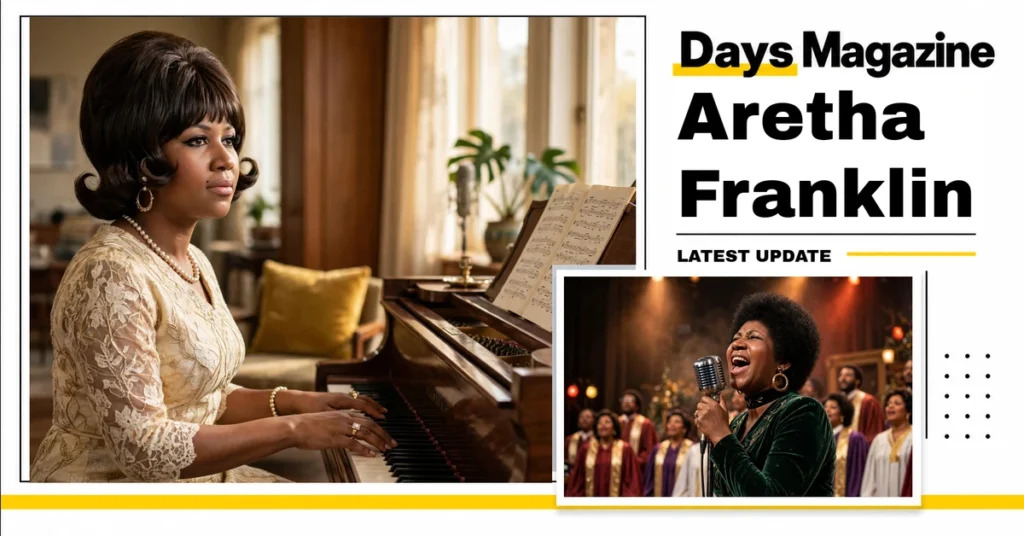
Aretha Franklin (March 25, 1942, to August 16, 2018) was an American singer, pianist, and songwriter whose gospel-rooted voice helped define soul music. Known worldwide as the Queen of Soul, she transformed “Respect” into an anthem of dignity and earned 18 Grammy Awards, becoming one of the most influential vocalists in American music.
Who Is Aretha Franklin?
Aretha Franklin was a Memphis-born, Detroit-raised singer, pianist, and songwriter whose work crossed gospel, soul, rhythm and blues, pop, jazz, and rock. Her power came from more than vocal range: she shaped songs through phrasing, piano playing, and emotional control, turning personal performances into music with broad cultural meaning.
Early Life and Family Roots in Detroit
Franklin was born Aretha Louise Franklin in Memphis, Tennessee, to C. L. Franklin, a prominent Baptist minister, and Barbara Siggers Franklin, a singer and pianist.
The family later settled in Detroit, where her father led New Bethel Baptist Church and became known nationally for his sermons. Music and public life were part of the household from an early age.
Franklin learned piano largely by ear and began singing gospel in church as a child. Her mother died when Aretha was still young, and her father helped guide her early musical development. By her early teens, she was traveling with his gospel shows and meeting established performers, including Mahalia Jackson and Clara Ward.
Her first gospel recordings were released in the 1950s, before she turned to secular music.
How Did Aretha Franklin Become the Queen of Soul?
Franklin moved to New York as a teenager and signed with Columbia Records in 1960, beginning a professional career outside gospel. Her early records explored jazz standards, blues, pop, and rhythm and blues, but they did not yet bring her the lasting breakthrough her talent deserved.
When her Columbia contract ended, she signed with Atlantic Records and found a sound that joined her church roots with blues and R&B.
At Atlantic, producer Jerry Wexler helped focus her sound. In 1967, Franklin recorded “I Never Loved a Man (The Way I Love You)” at FAME Studios in Muscle Shoals, Alabama. Her version of Otis Redding’s “Respect” followed and reached No. 1 on the Billboard Hot 100.
Franklin made the song her own through a commanding vocal, a sharp arrangement, and the unforgettable spelling refrain. It became a statement of self-worth and a soundtrack for civil rights and women’s equality.
Her success continued through the late 1960s and early 1970s, with albums such as Lady Soul, Aretha Now, Spirit in the Dark, and Young, Gifted and Black. In 1972, she returned to gospel for Amazing Grace, a live album recorded with a choir at New Temple Missionary Baptist Church in Los Angeles.
The record became one of the best-known gospel albums of its era and showed how closely her secular style remained tied to sacred music.
Key turning points in Franklin’s recording career included:
- 1960: Signed with Columbia Records and began releasing secular albums.
- 1967: Joined Atlantic Records and scored a major hit with “Respect.”
- 1972: Released the live gospel album Amazing Grace.
- 1980: Joined Arista Records and reached new audiences through albums and film appearances.
What Are Aretha Franklin’s Most Famous Songs?
Franklin’s best-known songs include “Respect,” “Chain of Fools,” “Think,” “(You Make Me Feel Like) A Natural Woman,” and “I Say a Little Prayer.” Her catalog also features “Rock Steady,” “Day Dreaming,” “Spanish Harlem,” “Freeway of Love,” and “A Rose Is Still a Rose.” These recordings reveal her range, from gospel-powered declarations to intimate ballads and danceable pop.
Franklin was also an interpreter who could make a familiar song sound newly personal. Her 1987 duet with George Michael, “I Knew You Were Waiting (For Me),” became a major international hit.
At the 1998 Grammy Awards, she stepped in at short notice to sing the opera aria “Nessun dorma” after Luciano Pavarotti became ill, demonstrating the flexibility of a voice most often associated with soul.
Aretha Franklin’s Children and Family
Franklin had four sons: Clarence, Edward, Ted White Jr., and Kecalf Cunningham. Her first two children were born when she was in her early teens, before her recording career reached national success. Ted White Jr., who performed as Teddy Richards, later played guitar in her band, while Kecalf pursued music as a gospel rapper.
Although Franklin was a major public figure, she generally kept her children out of the spotlight. Her family life was shaped by the demands of touring and recording, as well as by the support of relatives who helped care for her sons.
After her death, handwritten wills and questions about the estate led to a highly publicized legal dispute among family members.
Who Was Aretha Franklin’s Husband?
Aretha Franklin married twice, first to Ted White and later to actor Glynn Turman. She married White in 1961, and he also served as her manager during an important stage of her career. Their marriage ended in divorce in 1969 after a difficult period in their relationship.
Franklin married Turman in 1978 at her father’s church. The couple separated in 1982 and divorced in 1984. They did not have children together, and Franklin did not marry again. She remained focused on her music and family while maintaining a private personal life despite intense public attention.
Who Were Aretha Franklin’s Siblings?
Franklin’s siblings included singers Erma and Carolyn Franklin, as well as her brother Cecil, who became her manager. Erma and Carolyn performed background vocals and pursued music careers of their own. Their work connected Aretha’s success to a wider family tradition of gospel and R&B performance.
Cecil helped manage Franklin’s career after her first marriage ended. Her musical family offered both professional support and a close link to the church traditions that shaped her voice. The deaths of Erma, Carolyn, and Cecil before Aretha’s passing were major losses within the family.
What Movies Featured Aretha Franklin?
Franklin’s most famous film appearance was in the 1980 musical comedy The Blues Brothers, where she played Mrs. Murphy and performed “Think.” The scene introduced her to movie audiences and placed her commanding stage presence inside a comic musical story. She later appeared in concert films and television specials that documented her live performances.
The documentary Amazing Grace, released in 2018, captured Franklin recording her 1972 gospel album in a Los Angeles church. The footage had remained unreleased for decades, in part because of technical problems with synchronizing its sound and picture.
The 2021 biographical film Respect, starring Jennifer Hudson as Franklin, introduced a dramatized version of her life and rise to fame to a new generation.
How Did Aretha Franklin Support Civil Rights?
Franklin supported civil rights through performances, financial help, and close ties to people working for equality. She sang at Martin Luther King Jr.’s memorial service in 1968 and used her platform to support civil rights and women’s rights causes.
Her version of “Respect” became a powerful public symbol because its demand for dignity spoke to struggles beyond romantic relationships.
Her public honors reflected that influence. Franklin received the Presidential Medal of Freedom in 2005 and performed “My Country, ’Tis of Thee” at Barack Obama’s 2009 inauguration. She also sang at earlier presidential inaugural events and was honored at the Kennedy Center.
These appearances linked her music to major moments in American public life without reducing her legacy to politics alone.
Aretha Franklin Net Worth: What Is Known?
There is no single verified public figure that establishes Aretha Franklin’s exact net worth at death. Media reports have often repeated estimates near $80 million, but those figures should be treated as estimates rather than a confirmed accounting.
Her estate also faced tax obligations and legal proceedings over handwritten wills, which make simple online net worth claims especially difficult to verify.
Aretha Franklin’s Death and Lasting Legacy
Franklin died at her home in Detroit on August 16, 2018, at age 76, from advanced pancreatic neuroendocrine cancer. Her death prompted tributes from musicians, public figures, and fans who viewed her as both a defining singer and a cultural force.
The loss was felt across generations because her recordings had remained central to American music for more than five decades.
Her honors include 18 Grammy Awards, the Grammy Legend Award, the Grammy Lifetime Achievement Award, and induction into the Rock and Roll Hall of Fame in 1987, when she became its first female inductee. In 2019, she received a posthumous Pulitzer Prize Special Citation for her contribution to American music and culture.
Her legacy lives in her recordings, her influence on later singers, and the lasting meaning of songs such as “Respect.”
Among Franklin’s most important honors and milestones are:
- 1987: Became the first woman inducted into the Rock and Roll Hall of Fame.
- 1994: Received the Grammy Lifetime Achievement Award.
- 2005: Received the Presidential Medal of Freedom.
- 2019: Received a posthumous Pulitzer Prize Special Citation.
Aretha Franklin Quick Facts
These quick facts summarize the key dates, family details, and career milestones most often sought by readers.
| Fact | Details |
|---|---|
| Full name | Aretha Louise Franklin |
| Born | March 25, 1942, in Memphis, Tennessee |
| Died | August 16, 2018, in Detroit, Michigan |
| Known as | The Queen of Soul |
| Professions | Singer, songwriter, pianist, actress |
| Parents | C. L. Franklin and Barbara Siggers Franklin |
| Children | Four sons: Clarence, Edward, Ted White Jr., and Kecalf Cunningham |
| Spouses | Ted White and Glynn Turman |
| Grammy Awards | 18 wins |
| Major distinction | First woman inducted into the Rock and Roll Hall of Fame |
Her legacy belongs with the great music stories gathered here, from Dolly Parton and Madonna to Bob Marley and Liza Minnelli. Country fans can continue with Shania Twain, while Latin music readers will find Selena Quintanilla and Selena. Neo soul and modern songwriting round out the collection with Erykah Badu, Shaboozey, and Lewis Capaldi.
Conclusion
Aretha Franklin changed American music by joining gospel power with soul, R&B, pop, and other styles. Her 18 Grammy Awards and historic honors recognize a career of rare achievement, but her lasting impact is also heard in the emotional force of her songs.
From “Respect” to Amazing Grace, her work continues to give voice to faith, freedom, and self-worth.