Jane Goodall | Biography, Discoveries, Death & Legacy
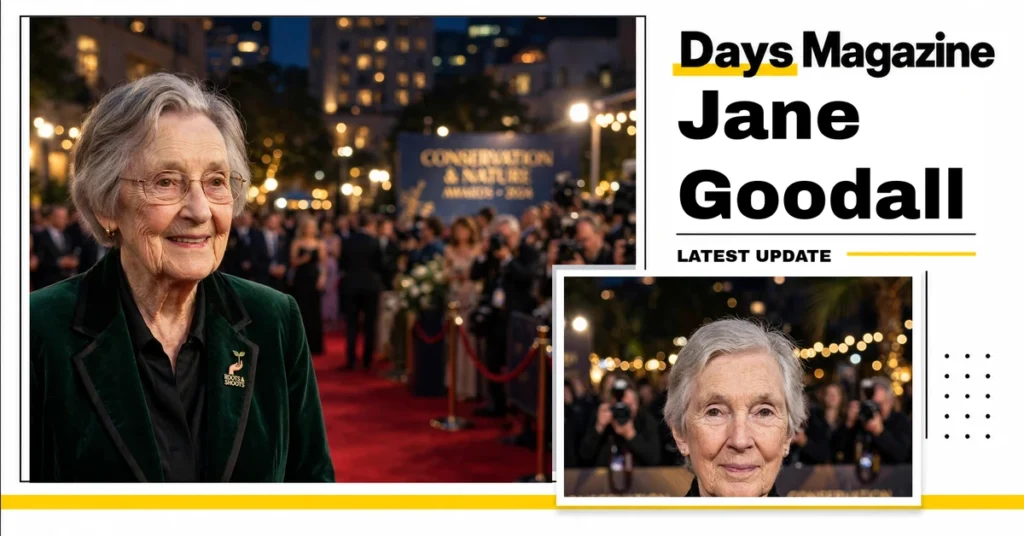
Jane Goodall was a British ethologist and conservationist who transformed how scientists understand chimpanzees. Beginning in 1960, she documented tool use, hunting, and complex social bonds at Gombe in Tanzania. After decades of research, she became a global advocate for wildlife and young people. She died in 2025 at age 91.
Who Is Jane Goodall?
Dr. Jane Goodall, born Valerie Jane Morris-Goodall, was a researcher, author, and environmental leader best known for her long study of wild chimpanzees. Her observations changed ideas about animal intelligence, while her later campaigns connected wildlife protection with the well-being of people living near natural habitats.
| Full name | Valerie Jane Morris-Goodall |
|---|---|
| Born | April 3, 1934, London, England |
| Died | October 1, 2025, Los Angeles, California |
| Age at death | 91 years |
| Known for | Chimpanzee research at Gombe and global conservation |
| Field | Ethology, the study of animal behavior |
| Education | PhD in ethology, University of Cambridge |
| Parents | Mortimer Morris-Goodall and Margaret “Vanne” Morris-Goodall |
| Husbands | Hugo van Lawick; Derek Bryceson |
| Children | One son, Hugo Eric Louis van Lawick (“Grub”) |
| Grandchildren | Merlin, Angel, and Nick |
| Organizations | Jane Goodall Institute; Roots & Shoots |
When Did Jane Goodall Die, and What Was Her Cause of Death?
Jane Goodall died on October 1, 2025, in Los Angeles at the age of 91. She had celebrated her 91st birthday on April 3 of that year, so her age at death is consistent with her verified birth date of April 3, 1934.
The Jane Goodall Institute said she died peacefully in her sleep of natural causes while visiting California on a United States speaking tour. The organization did not identify a more specific medical cause, so claims naming a particular illness should not be treated as established fact.
What Was Jane Goodall Like in Her Early Life?
Young Jane Goodall grew up with a strong interest in animals and the outdoors. Born in London, she spent much of her childhood in Bournemouth, England, with her mother, Vanne, and younger sister, Judy. Her father, Mortimer, gave her a stuffed chimpanzee called Jubilee, which became a treasured companion.
As a child, she once waited in a henhouse to see how a chicken laid an egg. Stories about Tarzan and Doctor Dolittle helped shape her dream of living among African wildlife, and her mother encouraged her curiosity rather than dismissing it.
What Education Did Dr. Jane Goodall Receive?
Jane Goodall entered chimpanzee research without a college degree and later earned a PhD in ethology at the University of Cambridge. Before traveling to Africa, she studied secretarial skills and worked to save money for the trip she hoped to make.
With Louis Leakey’s support, she began doctoral work at Newnham College, Cambridge, in 1962. The Jane Goodall Institute and National Geographic date her doctorate to 1966, while Cambridge’s Department of Zoology lists 1965 in its historical timeline. Both sources confirm that her field research led to a doctorate despite her lack of an undergraduate degree.
How Did Jane Goodall Begin Her Chimpanzee Research in 1960?
Jane Goodall began observing wild chimpanzees at Gombe on July 14, 1960, when she was 26. A friend’s invitation had brought her to Kenya in 1957, where she met paleontologist Louis Leakey, who recognized her patience and interest in animal behavior.
Leakey arranged for her to study chimpanzees beside Lake Tanganyika, in what is now Tanzania. Her mother accompanied her at first because authorities did not permit the young woman to work in the area alone. The animals were initially wary, so Goodall spent months observing them quietly from a distance.
What Did Jane Goodall Discover About Chimpanzees?
Jane Goodall showed that wild chimpanzees can make and use tools, hunt other animals, and form lasting social relationships. In 1960, she watched a male she named David Greybeard use grass or plant stems to collect termites, challenging the widespread belief that toolmaking belonged only to humans.
Her team later documented meat-eating, strong bonds between mothers and infants, cooperation, and serious aggression between groups. These findings presented a fuller picture of chimpanzee lives, including behaviors that were both caring and violent.
Why Was Jane Goodall’s Research Method Different?
Jane Goodall treated individual chimpanzees as recognizable animals with distinct histories and personalities. She gave them names rather than numbers and kept detailed observations over many years, allowing researchers to follow family ties and changes across generations.
Some scientists initially challenged her use of personal descriptions and the idea that animals could show emotion. Her early research also involved feeding chimpanzees, a practice later discontinued because it could affect their behavior. The continuing Gombe study remains important partly because its methods and questions evolved over time.
How Did Jane Goodall Turn Research Into Conservation?
Jane Goodall founded the Jane Goodall Institute in 1977 to support Gombe research and protect chimpanzees and their habitats. After a major chimpanzee conference in 1986, she devoted more time to the threats facing wild populations and the people who shared their landscapes.
Her conservation approach emphasized local involvement, not simply protecting animals behind park boundaries. The institute’s Tacare initiative began in western Tanzania in 1994 and linked habitat protection with community needs such as sustainable livelihoods and land planning.
What Is Jane Goodall’s Roots & Shoots Program?
Roots & Shoots is the youth action program Jane Goodall started in Tanzania on February 19, 1991, with 12 students. She encouraged the teenagers to identify challenges around them and create practical projects that helped people, animals, and the environment.
The program expanded to more than 75 countries. It reflects one of her main beliefs: young people should not have to wait until adulthood to make a useful difference in their communities.
Who Were Jane Goodall’s Husbands?
Jane Goodall married twice, first to Dutch wildlife photographer Hugo van Lawick and later to Tanzanian public official Derek Bryceson. Van Lawick filmed her fieldwork, and their partnership introduced many viewers to the chimpanzees of Gombe.
Goodall and van Lawick married on March 28, 1964, and divorced in 1974. She married Bryceson in 1975. He supported conservation efforts in Tanzania and died of cancer in 1980. Goodall did not remarry.
Did Jane Goodall Have a Son and Grandchildren?
Jane Goodall had one child, Hugo Eric Louis van Lawick, born in 1967 and widely known by his nickname, Grub. He was the son of her first husband, Hugo van Lawick, and spent part of his childhood in Tanzania during his mother’s research years.
She also had three grandchildren, Merlin, Angel, and Nick van Lawick. The Jane Goodall Institute identified them among her surviving relatives, along with her sister, Judy Waters. The family largely kept private matters outside Goodall’s public scientific work.
Which Jane Goodall Books Are Most Important?
Jane Goodall wrote widely for adults and children, turning scientific work into readable stories about animals and the natural world. These four books provide useful starting points for readers interested in her research and ideas:
- In the Shadow of Man (1971) | An account of her early years with the chimpanzees of Gombe.
- The Chimpanzees of Gombe: Patterns of Behavior (1986) | Her major scientific study of chimpanzee behavior.
- Reason for Hope: A Spiritual Journey (1999) | A personal reflection on meaning, faith, and the environment.
- The Book of Hope: A Survival Guide for Trying Times (2021) | Conversations with Douglas Abrams about reasons for hope.
Which Movies and Documentaries Feature Jane Goodall?
The 2017 documentary Jane, directed by Brett Morgen, uses historic footage shot by Hugo van Lawick to explore Goodall’s early research. The film offers a close look at the young scientist in the forest and the personal life unfolding alongside her discoveries.
Jane Goodall: Reasons for Hope, released in 2023, focuses on projects that address environmental challenges. Her voice also appears in Famous Last Words, a Netflix interview recorded before her death and released afterward in 2025.
What Were Jane Goodall’s Famous Last Words?
Jane Goodall recorded a final public message for the Netflix series Famous Last Words, but that recording should not be confused with the literal last words she spoke before dying. She filmed the interview in March 2025 knowing it would be shared only after her death.
In the message, she urged viewers not to give up hope and reminded them that everyday choices affect the world. The Jane Goodall Institute later highlighted the recording as a lasting statement of her outlook, rather than an account of her final moments in Los Angeles.
What Awards and Accomplishments Did Jane Goodall Receive?
Jane Goodall earned international recognition for scientific discovery, conservation, and public service. Among her major honors were:
- 1990 Kyoto Prize in Basic Sciences | Recognition of her field research on wild chimpanzees.
- 2002 United Nations Messenger of Peace | An appointment recognizing her advocacy for people and the planet.
- 2003 Dame Commander of the Order of the British Empire | The honor was officially gazetted in 2003.
- January 4, 2025 Presidential Medal of Freedom | The United States’ highest civilian honor.
Her most lasting accomplishment may be the long-term Gombe research program and the conservation organizations that continue her work after her death.
Was Jane Goodall Vegan, and What Were Her Religious Beliefs?
Jane Goodall adopted a vegan diet later in life and spoke about the effects of food choices on animals and the environment. She acknowledged that following a strict plant-based diet while traveling could be difficult, but argued that imperfect efforts still mattered.
She also discussed a broad spiritual belief in a higher power and a deep connection between living things. Her interviews do not support reducing that personal outlook to a single simple religious label; she emphasized respect for different beliefs.
What Was Jane Goodall’s Net Worth?
Jane Goodall’s personal net worth was not established by reliable public financial records. Online estimates vary, but they should not be presented as verified facts. The funding and international reach of the Jane Goodall Institute are separate from its founder’s private wealth.
Where Was Jane Goodall’s Funeral Held?
Jane Goodall’s funeral and celebration of life took place at Washington National Cathedral on November 12, 2025. The Jane Goodall Institute reported that more than 1,500 people attended, with tributes from her grandson Merlin van Lawick, actor Leonardo DiCaprio, scientist Francis Collins, and others.
The service honored not only her chimpanzee discoveries but also her message of compassion, youth action, and practical hope. Memorial gatherings in other countries likewise reflected the worldwide reach of her work.
Conclusion
Jane Goodall changed the study of chimpanzees and helped turn wildlife research into a worldwide call for action. From her first observations at Gombe in 1960 to her conservation work and youth programs, she showed how careful science could inspire practical change.
Her legacy continues through long-term research, habitat protection, and the people she encouraged to act.