Stephen Hawking | Biography, ALS, Death and Discoveries
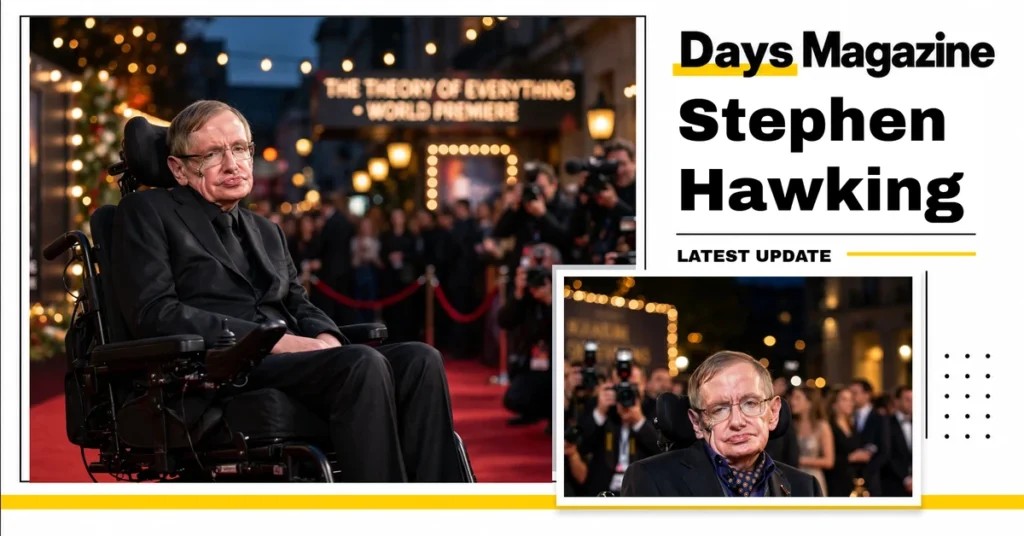
Stephen Hawking was a British theoretical physicist and author who transformed the study of black holes and helped millions of readers understand the universe. Best known for Hawking radiation and A Brief History of Time, he continued his research for decades after an ALS diagnosis. He died in 2018 at age 76.
Who Is Stephen Hawking?
Stephen William Hawking (January 8, 1942 to March 14, 2018) was a cosmologist and professor at the University of Cambridge. His work connected gravity, quantum physics, and the origins of the universe. He also became an international public figure through books, lectures, and a computerized voice that made his words recognizable worldwide.
| Full name | Stephen William Hawking |
| Born | January 8, 1942, Oxford, England |
| Died | March 14, 2018, Cambridge, England |
| Age at death | 76 years old |
| Known for | Hawking radiation, black hole research, cosmology |
| Education | University of Oxford; University of Cambridge |
| Occupation | Theoretical physicist, cosmologist, author |
| Spouses | Jane Wilde (married 1965); Elaine Mason (married 1995); both marriages ended in divorce |
| Children | Robert, Lucy, and Timothy Hawking |
What Was Stephen Hawking Like Before His Disability?
Young Stephen Hawking grew up in Oxford, London, and St Albans before studying physics at Oxford University. His father, Frank Hawking, worked in medical research, while his mother, Isobel, supported his curiosity. School friends called him “Einstein,” even though he was not always among the highest-ranking students.
Hawking entered University College, Oxford, at 17 in 1959 and earned a first-class degree. He moved to Cambridge in 1962 for graduate research in cosmology. Before his illness became clear, he walked without a wheelchair and enjoyed activities such as rowing. His disability was not caused by one accident.
What Disease Did Stephen Hawking Have?
Stephen Hawking had amyotrophic lateral sclerosis (ALS), a type of motor neuron disease that gradually damages the nerve cells controlling voluntary muscles. Doctors diagnosed him in 1963, shortly after his 21st birthday, and initially suggested he might live only about two more years.
He had begun noticing clumsiness and difficulty with movement while still a student. His condition progressed unusually slowly, allowing him to live for roughly 55 years after diagnosis. ALS affected his mobility, speech, and muscle control, but it did not erase his ability to think or do advanced mathematics.
How Did Stephen Hawking Become Paralyzed?
Hawking became severely disabled through the gradual progression of his motor neuron disease, not from a sudden injury. As muscle weakness increased, walking became harder and he eventually relied on a wheelchair. By his later years he had very limited voluntary movement.
Descriptions of Stephen Hawking before ALS sometimes confuse early signs of illness with an accident on the ice during his youth. That incident helped draw attention to his symptoms, but it was not the cause of his paralysis.
What Did Stephen Hawking Discover About Black Holes?
Hawking’s most famous scientific prediction was Hawking radiation, introduced in 1974. He showed through theoretical calculations that black holes should emit a faint form of radiation because of quantum effects. Over extremely long periods, this means they can lose mass and may eventually evaporate.
His research helped bring together two major areas of physics that are difficult to combine: Einstein’s theory of gravity and quantum mechanics. His work also helped create the black hole information paradox, a question about what happens to information when matter falls into a black hole.
Several major contributions shaped his career:
- With Roger Penrose, developed influential singularity results connected to general relativity and the Big Bang.
- Predicted black hole radiation in 1974 and developed the idea in later scientific papers.
- Worked with James Hartle on the no-boundary proposal, a model for the universe’s earliest state.
- Explored whether information can be preserved when black holes lose mass.
Hawking radiation remains a powerful prediction, but detecting it directly from an astrophysical black hole is extremely difficult. His scientific importance does not depend on claims that every idea was experimentally proven.
How Did Stephen Hawking Become a Famous Professor?
Stephen Hawking became Cambridge’s Lucasian Professor of Mathematics in 1979 and held the position until 2009. Isaac Newton had occupied the same historic chair centuries earlier. Hawking remained active in research and scientific discussion after leaving the post.
He was elected to the Royal Society in 1974, received a Commander of the Order of the British Empire honor in 1982, and was named a Companion of Honour in 1989. President Barack Obama awarded him the Presidential Medal of Freedom in 2009. He never received a Nobel Prize in Physics.
How Did Stephen Hawking Talk Through a Voice Generator?
Hawking used a speech synthesizer after a tracheostomy in 1985 took away his natural speaking voice. He had developed severe pneumonia while traveling in Europe, and the operation helped him breathe. At first, he communicated by pointing to letters and using small facial movements.
Computer software later allowed him to select words and send them to a speech device. He first used a hand-operated switch; as his movement decreased, an infrared sensor on his glasses detected a cheek muscle. Engineers, including teams at Intel, improved his system while he kept its distinctive electronic American-accented voice.
Who Were Stephen Hawking’s Wives and Children?
Stephen Hawking married Jane Wilde in 1965, and they had three children: Robert in 1967, Lucy in 1970, and Timothy in 1979. Jane supported his early career while raising their family and dealing with growing demands for medical care. They separated around 1990 and later divorced.
He married Elaine Mason, who had worked as one of his nurses, in 1995. That marriage ended in 2006. Public accounts of the relationships sometimes focus on cheating or disputed personal claims, but rumors should not be treated as established facts. His daughter Lucy later collaborated with him on science books for children.
Which Stephen Hawking Books Are Most Important?
Hawking’s best-known book is A Brief History of Time, published in 1988. It explained questions about the Big Bang, time, and black holes for readers without specialist training. Its commercial success made him one of the world’s best-known science writers.
Important titles include:
- A Brief History of Time (1988), his landmark introduction to cosmology.
- The Universe in a Nutshell (2001), an illustrated guide to modern physics.
- The Grand Design (2010), written with Leonard Mlodinow about physical laws and the universe.
- Brief Answers to the Big Questions (2018), published after his death.
He also worked with Lucy Hawking on the George series of children’s science adventures. His writing connected complex research with everyday questions about where the universe came from and how it works.
Did Stephen Hawking Believe in God?
Hawking argued that physical laws could explain the universe without requiring a divine creator. In The Grand Design, he presented scientific explanations for the universe’s origin, while public interviews showed that he understood religious belief and scientific explanation as different kinds of claims.
He sometimes used the word “God” as a figure of speech when discussing the laws of nature. Such references should not be mistaken for proof that he held one fixed religious view throughout his life.
What Movie Was Made About Stephen Hawking?
The Theory of Everything, released in 2014, portrayed Hawking’s early career and his marriage to Jane. Eddie Redmayne played Hawking, and Felicity Jones played Jane. The film drew on Jane Hawking’s memoir and focused more on family life than detailed physics.
Redmayne won the Academy Award for Best Actor in 2015. Hawking also appeared or was referenced in popular shows such as The Simpsons and The Big Bang Theory, helping bring physics into mainstream entertainment.
Was Stephen Hawking Named in the Epstein Files?
Yes. Stephen Hawking was mentioned in court records connected to Jeffrey Epstein, and he attended an Epstein-funded physics conference in the U.S. Virgin Islands in March 2006.
Reporting published in 2026 also described a short group outing to Epstein’s private island as part of that scientific gathering. Being named in a record or attending the event does not establish criminal wrongdoing.
A 2015 email in records released in January 2024 discussed an effort to rebut an allegation involving Hawking. The email is evidence that an allegation was discussed, not proof that the alleged event happened.
Another record requested any photos or videos of an accuser with various people, including Hawking. No verified public evidence in these reports established that Hawking committed sexual abuse.
Images circulating online need equal care. A picture of Hawking with two women in swimsuits was identified by his family as showing his carers at an Orlando hotel in April 2007, not an Epstein island scene.
In March 2026, AFP also debunked AI-generated pictures falsely claiming to show Hawking with Bill Clinton in the Epstein files. No reliable conclusion about personal conduct can be drawn from those fabricated images.
What Was Stephen Hawking’s IQ and Net Worth?
There is no verified public IQ score for Stephen Hawking. Numbers such as 160 appear online, but a documented standardized test result has not been established. His scientific work and professional record offer much stronger evidence of his ability than an unsupported numerical label.
His exact net worth at death is also not publicly verified. Websites have published estimates, but estimates should not be confused with an audited account of his assets or estate. His income sources included academic work, books, and public appearances.
When Did Stephen Hawking Die, and What Was His Cause of Death?
Stephen Hawking died at home in Cambridge on March 14, 2018, aged 76. His family said he died peacefully but did not announce a specific immediate medical cause of death. His long history of ALS is well documented, yet that alone does not establish a precise final medical event.
There is no reliably authenticated public record of his exact last spoken words. Quotes frequently shared under his name should be checked against books, lectures, or recorded interviews before being presented as his words. His ashes were interred at Westminster Abbey in June 2018, near the graves of Isaac Newton and Charles Darwin.
Conclusion
Stephen Hawking changed how scientists think about black holes while helping ordinary readers ask bigger questions about space and time. His life spanned major scientific discoveries, decades of work with ALS, two marriages, and a worldwide writing career. The strongest account of his legacy rests on documented research and history, not unverified stories.